And yes, I kept writing because by now I couldn’t NOT write.
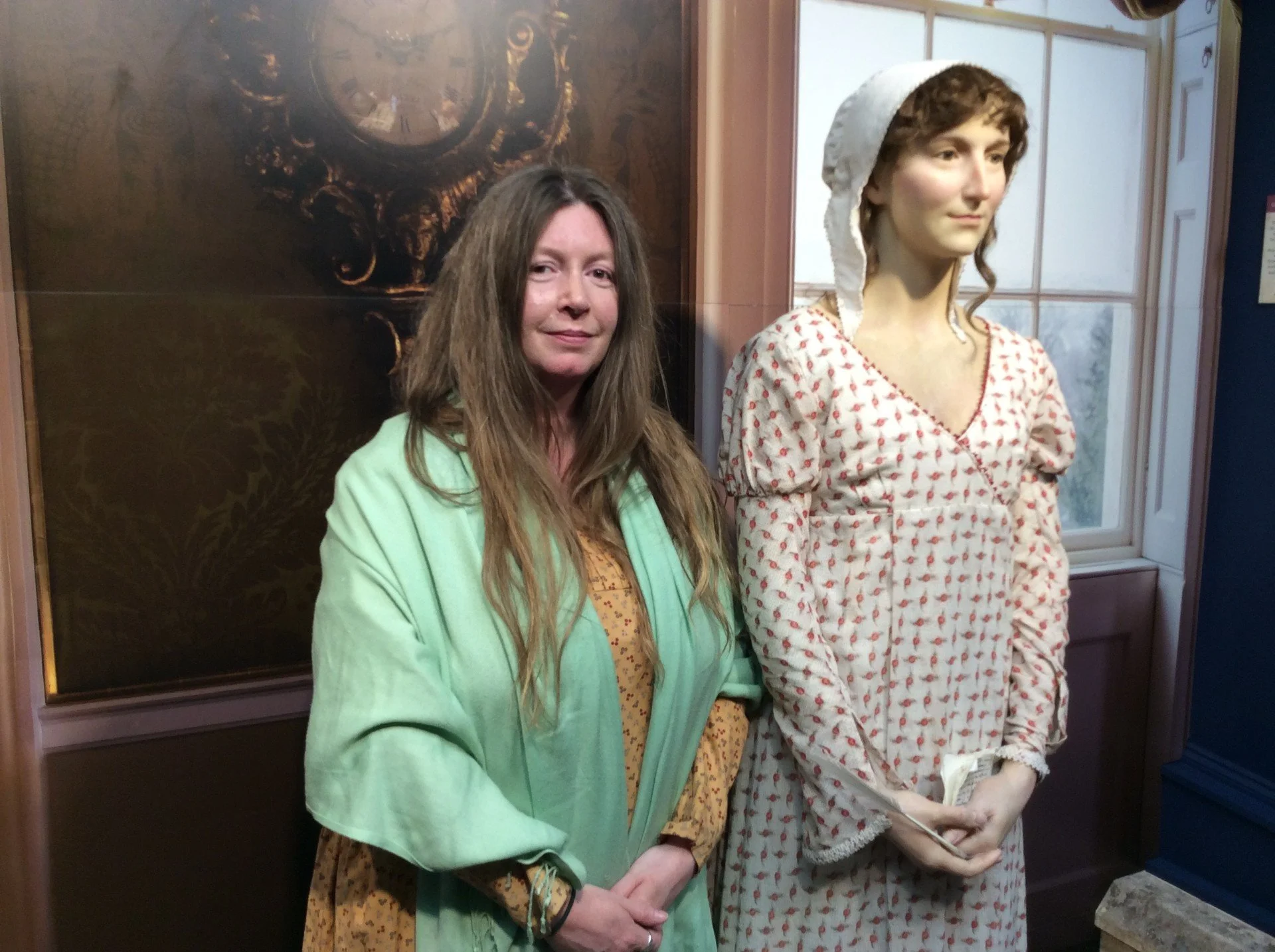
Me at the Jane Austen Centre in Bath. Photo by my sister.
Writing did help me put myself back together after bereavement. It’s an act of Hope, saying: I don’t know if anyone will ever read this but I’m going to write it anyway. Or: I don’t know if I CAN write this, but I’m going to try. Writing can be huge fun, but often it can be a struggle. Not just because of challenges fitting it in around everyday life commitments. Brain fog, chronic exhaustion, are issues for me, and have been for years. Often, it’s like the words have to be dragged out fighting every step of the way. But I can’t not write. Even if it’s just a few lines scrawled on paper to be typed up later, for me writing is hope.
The next book I wrote was an enemies-to-lovers Fantasy Romance with dragon shapeshifters. It also had interest from Agents, but this was before Romantasy became popular. It wasn’t until I wrote WITCHLAND that I finally got my first Agent. I’d pitched WITCHLAND as ‘Bridgerton with witches and dragons.’
I learned a lot about writing over the time I spent querying – with several books – and it took the best part of 10 years to succeed. By then I knew that writing well, even writing a great book, isn’t enough: it must have strong commercial appeal. The Agent must REALLY LOVE it, enough to read that novel several times across edits, then still feel strongly enough to enthusiastically pitch it to Editors with limited slots for taking on books (and even fewer for Debut Authors).
Getting my first Agent was exciting. Someone else loved WITCHLAND, the characters, the world I’d created, and believed it had strong commercial potential! Amazing validation, though I knew this was just the first hurdle, with more edits ahead. Sadly, we later had to part ways before the book could go out on submission to Editors. At the time, it was a crushing setback that floored me, but I learned so much from my Agent’s editorial notes and the book was stronger.
Every writer pursuing traditional publishing experiences rejection over and over. Querying Agents, being on submission when your Agent sends it to Editors, because even if the Editor loves it, they let it go if they can’t get colleagues onboard with buying it. If you get published, some readers will enjoy the book but not have time to review it, whilst others will dislike it and leave bad reviews.
When setbacks happen, there’s a choice: give up or continue. It’s ok to take time out to be upset and angry, because even though it’s not personal – we all know good books still get rejected – it feels personal when you’ve worked hard to get a book ready (in my case, all the time dealing with Chronic Fatigue) and spent years getting an Agent to take you on (whilst writing more books to pitch later in case they rejected the one I was querying).
It comes down to hope and believing in the book you’ve written. Back then, I didn’t have the confidence to explore self-publishing: that felt like an impossible learning curve, because I was tired and didn’t have the brain space for getting to grips with it.
I still wanted the validation and reach that I thought would come with a traditional publishing deal. Giving up that dream, to me, meant that readers would never step into the world of WITCHLAND, never ‘meet’ Eliza and Will, or Eliza’s dragon Erevus who likes to shapeshift to the size of a cat to steal food from the kitchens. So, I had to keep going.
My wonderful writing friends – the J Team aka The (Writing) Coven – got me through that awful time after I parted ways with my first Agent. One of them heard about a new Agent who had only just opened for queries and wanted Romantasy books. I pitched WITCHLAND and that’s how I got my second Agent.
After another edit, my lovely new Agent sent WITCHLAND out on submission to Editors. I carried on writing the next novel in the series, whilst developing other book ideas. It was an exciting and anxious time, waiting for news. Some Editors loved WITCHLAND but couldn’t get the whole team behind it, so couldn’t buy it. Others felt it wasn’t quite a fit for their list. A couple asked for a Revise and Resubmit, so I did another edit, but unfortunately they didn’t buy the book. Shortly after that, my Agent decided to leave Agenting. We did get a translation deal for the first two books in the series, which the Agency handled, but I was Agentless again.
And I was gutted. I’d enjoyed working with both my Agents and learned a lot from them*.
With WITCHLAND, I knew I had a book with a commercial premise, of the right standard to be published (if it wasn’t, I wouldn’t have got as far as I did). I wasn’t ready to give up on it. I had a full draft of Book 2 and wanted to complete the series. So, I decided to self-publish.
* I would love to work with an Agent again, and I’d also consider working directly with independent publishers.