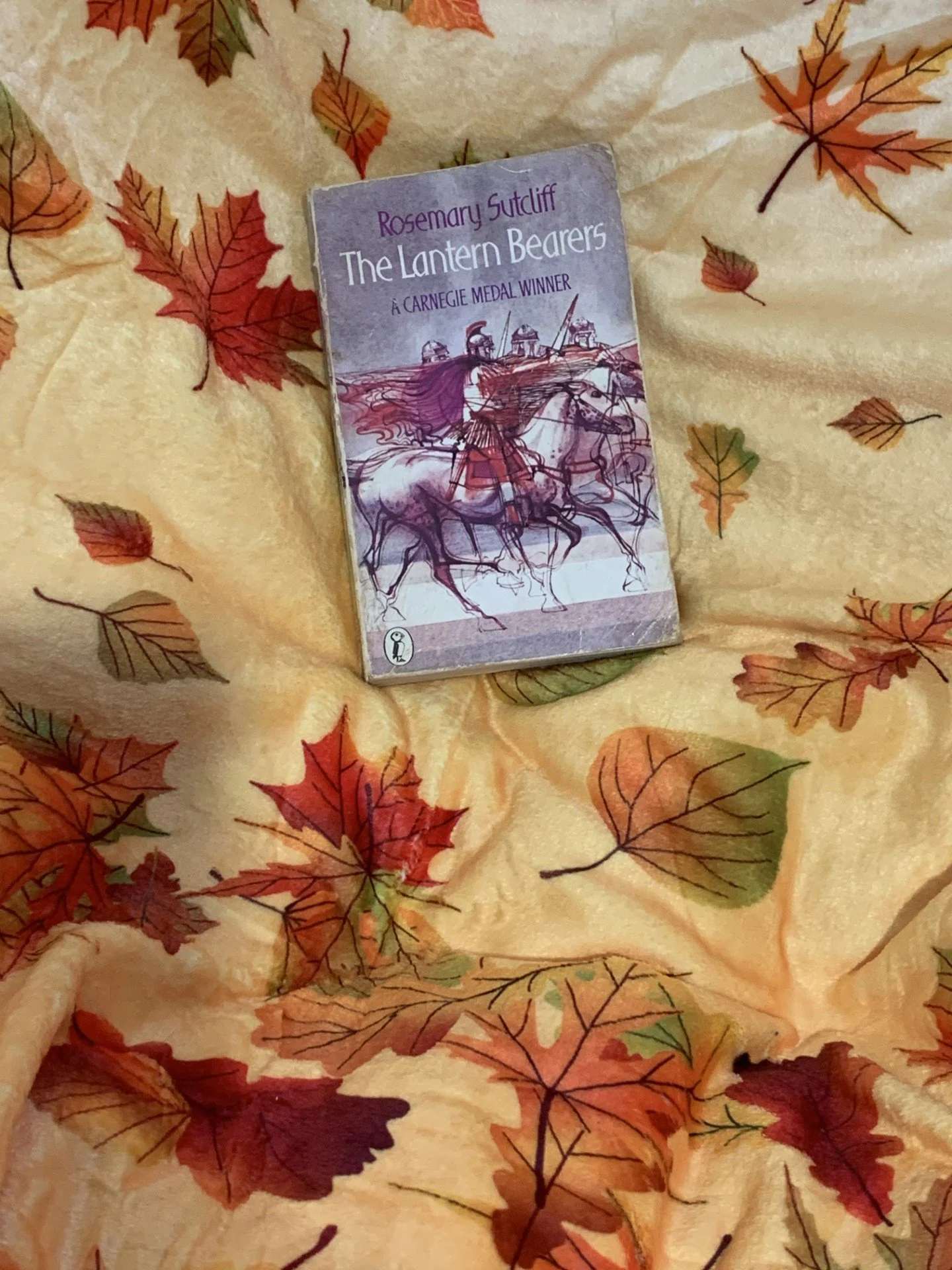
‘The Lantern Bearers’ made me want to be a writer.
It might be the season – autumn, for me, is a time of feeling drawn to thoughts of the past – but lately I’ve been feeling nostalgic about books I read when I was in my early teens, the ones that made me want to be a writer. My very first blog post has the story of how I became a writer, but today I want to share more about the wonderful books that inspired me to either take the first step or kept me going when life got tough.
I’ve always been an avid reader, ever since I learned to read. I can’t remember much about the earliest books – the one clear memory I have about those was a picture book I borrowed from the infant school library, I can still see the illustration of the big smiling whale in that story. I also fondly remember a story about a boy who had wallpaper with all sorts of wild animals in a jungle, and when he fell asleep, he stepped inside that world and met them all.
I started reading Rosemary Sutcliff’s historical novels before I was ten years old and continued reading them into my teens. I began with her most famous book ‘The Eagle of the Ninth,’ set in Roman Britain, which is about a young man who’s determined to discover what happened to his father, who disappeared with the lost Ninth Legion. I loved the story because it had adventure, a mystery, found friendship and even a hint of romance. So, I kept reading Rosemary’s books, my favourites being her Roman Britain novels (though I have a soft spot for ‘Knight’s Fee,’ even though it broke my heart).
Much later, I learned that Rosemary Sutcliff wrote these wonderful books despite her health issues. That inspired me in a different way, because during my teens I suffered M.E. (chronic fatigue) after having several viruses back-to-back. She continues to inspire me today, as I write through fatigue issues, brain fog and concentration problems.
It was Rosemary Sutcliff’s ‘The Lantern Bearers’ that inspired me to start writing longer fiction. Before this novel, I’d written home-made comics with my sister, and a few short stories for my own amusement. ‘The Lantern Bearers’ enthralled me. It’s a story rich in conflict, set in the years after the Romans withdrew their legions from a Britain that was facing attacks from the Saxons. The main character Aquila has divided loyalties right from the start. He’s meant to leave Britain with the legion he’s serving in, but if he does, that means leaving his parents and sister undefended whilst the Saxon raids are creeping closer. It’s a story about family, making difficult decisions, and trying to survive in an uncertain world… and it sets the stage for the coming of King Arthur, because Aquila joins the armies led by Arthur’s father Uther and uncle Ambrosius Aurelianus.
It was grey-eyed Ambrosius who made me want to write longer fiction. He only has a few scenes, but teenage me was fascinated by him. I guess he was my first Book Boyfriend (long before the idea of Book Boyfriends became a thing). I even folded over the corner of each page where a scene with Ambrosius started, so I could re-read them!
I was angry when Rosemary killed him off in ‘Sword at Sunset’ to make way for his nephew, King Arthur. I decided to do something about it, writing my own alternative story – fan fiction! – and bringing him back to life for more adventures.
Of course, we can’t know what the real Ambrosius was like, but Rosemary Sutcliff wrote him as a dark haired young man with pale grey eyes lit with gold and a swift smile that lit up his face, a man who was intelligent and a survivor, having rebuilt his life after his father was murdered. In ‘The Lantern Bearers’ he’s a canny strategist dedicated to serving and protecting his people, even putting their needs before his personal happiness.
Sounds familiar? When I was writing WITCHLAND, I wanted to make Eliza a woman who’s determined to serve and protect both her sister and the families on her Estate. When she’s Challenged to a magical duel, Eliza knows many of them will die if she loses, since a new Matriarch is entitled to execute her predecessor’s closest supporters and immediate family. She decides to marry – her Estate will give her more magic as a wedding gift – and because Eliza’s cursed to kill her husband she picks a man she dislikes, so she won’t mourn him when she dies.
The starting point for Eliza was that she would be a female version of Jane Austen’s Mr Darcy, someone who hides her feelings beyond a cold, even haughty exterior. Darcy, as we discover later, is a kind and diligent landowner who looks after his people, capable of deep love. All this fed into Eliza’s character. Another big influence was Daenerys in George R R Martin’s ‘A Song of Ice and Fire’ series. Eliza was always going to be a dragonrider – the first scene I wrote introduced her bond with her dragon familiar, Erevus – but after the travesty of an ending that the Game of Thrones TV series gave us, I was raging.
Not only was Daenerys, my favourite character, demonised but the narrative was lazy, rushed storytelling, coming down to choosing the option that provided visual spectacle, though even that failed because the change in her character was so abrupt the ‘spectacle’ felt empty. I was just angry watching the destruction unfold. The Daenerys of the books is a young woman who goes out among her suffering people, risking her life to tend plague victims, and I don’t believe she would intentionally massacre innocents.
I feel strongly that the TV show’s ending isn’t what George R R Martin has planned for Daenerys. He’s said he admires characters who try to make a better world, even if they don’t succeed. Yes, he would have shared some details of the story arc with the showrunners, but no writer would give away their planned finale because doing so would rob their loyal readers of discovering it when their books come out.
Worst of all, the ending of the Game of Thrones TV series came down to that tired old cliché ‘Absolute power corrupts absolutely.’
I don’t believe that power inherently corrupts; it’s what’s in the heart and mind of the person wielding it that determines how well power is used… and sometimes there are necessary constraints around how it can and should be used. Telling ordinary people ‘Power corrupts’ certainly discourages them from seeking it, and it stops people even trying to change the world. ‘Power corrupts’ is a harmful narrative because our world needs ordinary people who are passionate about making it a better place, whether that’s through everyday kindness or through seeking the power to raise awareness of issues or even push for change (in a peaceful democratic way).
So, when I created WITCHLAND, I made it a realm where Matriarchs serve and protect their people. Even the most powerful leader, its queen, sets her strength to ensuring the safety of her people.
And Eliza, our heroine in WITCHLAND, is prepared to sacrifice her happiness and marry a man she dislikes, in order to keep her sister and people safe.
I wasn’t consciously thinking of Ambrosius as I wrote Eliza but looking back I can see how he influenced my deep belief that leaders should serve their people, and that fed into WITCHLAND.